
I was asked by my cousin Jen if I could do a little write up to clarify the difference between vegetable oil and canola oil. Thought that was a great idea and that I could actually expand on that to talk about a couple of other commonly used oils as well.
Looking back through my culinary notebooks, I found a nice little section that talked about "Fats in the Kitchen." While nutritionally fats are not necessarily good for you (understatement), in the kitchen they are essential. Fat is where your flavor is and you use fats to bake, fry, cook, and dress (as in salads).
You should probably be aware that not all oils are interchangeable. Some of better for baking, some are better for stove-top use, and some are better for frying…and even within that category some are better for frying at high temps while others are better for frying at low temps, depends on their smoking point. Smoking point refers to the temperature at which a cooking fat or oil breaks down and, literally, starts to smoke. The smoking point is also where the flavor and any nutritional value start to degrade (degrade = bad, but then again so does smoke in a kitchen).
COOKING OILS
So what are the most common types of oils used in the kitchen?
Vegetable Oil – most veggie oils are a combo of various oils. The most commonly used ones are corn, soybean, palm, and sunflower, all of which have very high smoking points, between 440-460°F, which make vegetable oil good for high temperature frying. It’s also great to use in baking, not so much for your salad dressing mixes though. Unfortunately, veggie oil is high in omega-6 fatty acids so doesn’t make it a strong nutritional candidate.
Canola Oil – canola is made from rapeseed, a type of (bright yellow) field mustard. Nutritionally, next to olive oil, this is your best bet. It can be used for frying, but at medium temperatures (smoking point of 400°F). It’s good for baking, but can also be used in salad dressings. Canola oil is low in saturated fats (bad fats) and high in monounsaturated fats (good fats) and has omega-3 fatty acids (also good for you).
Sunflower Oil – is made from sunflower seeds. It has a moderately high smoking point at 440°F. It’s low in saturated fats and high in vitamin E (a fat-soluble antioxidant). I read that because it has some health benefits, it is preferred by companies to use in making their snack foods (e.g., chip companies). It can be used to fry, bake or dress.
Peanut Oil – is made from peanuts. While most highly refined peanut oils have removed the allergens to make it safe for use/consumption by the majority of people with peanut allergies, if you’re not sure about it, then I recommended not using it at all. Its smoking point has been listed anywhere from 437-450°F which means it’s good for high temperature frying. In fact, it’s the most commonly used oil to fry turkeys with at Thanksgiving.
Olive Oil – is considered the healthiest of oils being that it is very high in monounsaturated fats. While it is great for dressing of the salads and stove top and low temperature cooking, it’s not a great high temperature frying oil. I have used olive oil in some specialty baking products, but for cakes and pies, I find it doesn’t work as well as some of your other oils.
HOW TO
Store – no matter what kind of oil you have, you should make sure to store them at room temperature where they can maintain their liquid state. In a dark, dry place like a pantry is best. Oils with high monounsaturated content will keep up to a year that way. Certain refined olive oils will keep up to a couple of years. The shelf life of most other oils is approximately 6-8 months after opening.
Dispose – the best way to get rid of any used oil is to put it in a leak proof container and take it out with your regular garbage. Alternatively, you may be able to take it to a special disposal facility (where you take used oils and paints). You should NEVER pour it down your sink drain because oils have a tendency to congeal, especially at cooler temperatures, and will block your pipes, messy and expensive to fix.
Thanks, Coz, for your question. I actually wasn’t familiar with the distinction between the first two types of oil myself and now we all know! (We are getting SO smart.)
Wednesday, May 16, 2012
Oil v. Oil
Sunday, May 13, 2012
Mother's Choice: Sunday Apple Fritters

In honor of the holiday, today's recipe was chosen by Guinea Pig Mom. We went back to one of my other favorite cookbooks to try this one out for you. From the Southern Living Off the Eaten Path by Morgan Murphy (Oxmoor House, 2011), she asked me to whip up a batch of yummy apple fritters from Lucille's Roadhouse in Weatherford, Oklahoma. You gotta love a woman who's happy with fried dough for a gift. I love you Mom!
Sunday Apple Fritters
Oklahoma, page 181, Off the Eaten Path
Canola oil
2 cups all-purpose flour
2/3 cup sugar
1-1/2 tsp baking powder
1 tsp salt
2 large apples, unpeeled and finely chopped (about 3 cups)
2/3 cup milk
2 tsp vanilla extract
2 large eggs
Powdered sugar
Pour oil to depth of 2 inches into a Dutch oven (or electric wok); heat to 350 degrees.
Combine flour and next 3 ingredients. Stir in chopped apples, tossing gently to coat.


Make a well in the center of the mixture. Whisk together milk, vanilla, and eggs until blended.


Drop batter by rounded tablespoons into hot oil.

Fry fritters in batches, 1 to 2 minutes on each side, or until golden.


Drain on paper towels.

Sprinkle fritters with powdered sugar. Makes 3 dozen.
NOTES
Off the Eaten Path author's note -- "We tested with Braeburn apples." And so I figured why not do the same. In post-consumption discussions with the Guinea Pigs, it was decided that you could also use not-totally ripe peaches, firm strawberries, pears, or mango in lieu of the apples and it would work well too.
The reason I used an electric wok to fry mine up was because (and I know this may come as a shock), I don't actually own a Dutch oven. But the advantages to using the wok instead are (1) I can still set the temperature easily and (2) because of the shape of the wok, even though I use less oil I still have a wide surface area to fry the fritters up in.
As a variation, you could sprinkle your fritters with cinnamon sugar instead of powdered sugar.
Did I mention these were REALLY good?
Wednesday, May 9, 2012
Baked Eggs in Prosciutto Cups

This one looked simple and simply delicious so I thought I'd give it a whirl. Don't know if you're as big a fan as I am of breakfast for dinner, but this variation on bacon and eggs is definitely worth trying.
Baked Eggs in Prosciutto Cups
Morning Glories: Breakfast & Brunch
Page 14, Muffin Tin Chef
12 thin slices prosciutto
2 tbsp grainy mustard or Dijon mustard
1/4 cup finely chopped basil
1/3 cup grated Parmesan cheese (about 1 oz)
6 large eggs
chopped fresh chives, for garnish
salt and pepper
Preheat the oven to 375 degrees. Grease 6 medium muffin cups with oil or butter and line each with 2 slices of prosciutto, enough to cover the bottom and sides completely.

Because the prosciutto slices were long, I folded mine
them in half so ended up with four layers per cup.
Spread mustard on the bottom of the prosciutto-lined cups, and top with basil and cheese. Press down lightly on the cheese to make room for the eggs.


Couldn't find any fresh basil, so used a basil paste,
it may not be fresh, but it smells amazing.

I forgot to pick up a block of Parm at the store to
hand grate so used the shaker kind and found I
didn't need to press down the cheese to make room.
didn't need to press down the cheese to make room.
Carefully crack an egg into each prosciutto cup. Season the tops of the eggs with salt and pepper.

Place the muffin tray on a baking sheet to catch any egg overflow.
Bake until the egg whites are set but the yolks are still slightly runny, about 17 minutes.

Let cool for 5 minutes before unmolding. Garnish with fresh chives. Serves 3.
NOTES
Author's Note: "Prosciutto is a thinly sliced cured ham originally from Italy and a wonderful alternative to bacon in this recipe. Unlike most muffin tin creations, these don't make good leftovers, so only prepare what you can eat at once. They can also anchor a dinner mean. Serve with a crusty bread for dipping into the runny yolks."
In case you missed it Sunday, this recipe is from Muffin Tin Chef by Matt Kadey (Ulysses Press, 2012, ISBN 987-1-61243-052-2).
This is the paste I used, see it even claims "chopped fresh" so it kind of counts. Did I mention it smells great?

Sunday, May 6, 2012
Check It Out: Do you know the Muffin Tin Man?

I really think that you are going to love cooking from Muffin Tin Chef: 101 Savory Snacks, Adorable Appetizers, Enticing Entrees & Delicious Dessers by Matt Kadey (Ulysses Press, 2012). My friend Ducky was in town this weekend and picked this one out for me to try and to share with you. She made a good choice, I hope you think so too.
Sweet Potato Shepherd's Pie
Main Dishes, page 90, Muffin Tin Chef
2 medium sweet potatoes, peeled and diced
1 tbps unsalted butter
1/4 tsp ground nutmeg
2 tbsp flour
1 tbsp grapeseed or canola oil
1 small onion, finely diced
1 medium carrot, finely chopped
1 medium turnip, finely chopped
3 garlic cloves, minced
1/2 cup frozen corn kernels
2/3 pound ground turkey breast or chicken breast
1/2 cup bread crumbs
2 tbsp tomato paste
2 tsp grainy mustard or Dijon mustard
1 large whole egg, lightly beaten
1 large egg white
1 tbsp fresh thyme or 1 tsp dried thyme
1/4 tsp salt
1/4 tsp pepper
1/2 cup grated Parmesan cheese (about 2 oz)
Steam or boil the sweet potatoes until very tender. Transfer to a medium bowl and mash with the butter, nutmeg, and flour; set aside.


NOTES
This is one time I will NOT tell you it's okay to substitute beef or pork for the ground turkey or chicken. The reason being that the latter doesn't cook off any grease that would sit in the bottom of the tin cups and make the pies unpalatable, the former would.
I chopped my veggies pretty small, but they could have been even smaller and it would have worked out okay. It would have cut down the chances of the pies fallen apart when being removed even more.
When removing the pies from the cups, make sure to loosen around the edges first and then make sure to support the bottom when pulling out. Again this is where making my veggie cuts even smaller would be helpful, making the pies less chunky.
If you decide you want to use potatoes instead of turnips, like I almost did, make sure they are parboiled before throwing into the skillet. If you start with raw potatoes, they won't cook as well or as fast as the other ingredients and might still be "al dente" when you serve the pies.
More detailed information about the book, ISBN 978-61243-052-2, 160pp, 6.5 x 9" paperback, $15.95. It's got lots of sexy color photos of the products and yes, I already know that my final product doesn't look as glamorous as what's in the book, but it still tastes as delightful as it sounds.

Wednesday, May 2, 2012
Just a quick note...
So there's been a lot of "sharing" going around at work and I managed to bring home a sweet little virus that had me laid up on the couch all day with a problematic stomach which is not at all condusive to playing in the kitchen so I will not be bringing you a recipe tonight. :(
BUT I'm assured I will be up and cooking again this weekend and as a bonus, I may throw in the homemade gatorade drink recipe that the doctor gave me...once I try it out a couple times first.
So have a good evening and I'll be back soon. Promise!
Sunday, April 29, 2012
The Colors Blue/Purple: Blueberry Sauce

Today is sort of a two-fer, not only am I featuring blueberries as my blue food, but they are also a superfood which means they are Good and Good For You.
The BLUE and PURPLE category get their coloring from natural pigments known as anythocyanins. The anthocyanins in purple grapes, raisins, and blueberries are especially powerful antioxidants which help prevent cell damage.
Eating even a small handful of blueberries a day can help with healthy aging and prevention of memory loss. They also contain a compound that aids in lowering cholestrol. So blueberries basically rock.
Other fruits and veggies that fall into the blue/purple group are blackberries, blue corn, blue potatoes, eggplant, figs, plums, prunes, purple grapes, and raisins.
Blueberry Sauce
1 cup sugar
2 tbsp cornstarch
1/4 tsp nutmeg
dash of salt
1 cup boiling water
2 cups fresh blueberries
3 tbsp lemon juice
In a deep sauce pan combine sugar, corn starch, nutmeg, and salt.


Add in blueberries and bring to a boil again. Cook for 2 minute, stirring occasionally.


You can substitute frozen unsweetened blueberries, but they need to be thawed and drained. Increase cornstarch to 3 tbsp. Bring mixture to a boil, then remove from heat and add in blueberries and lemon juice at the same time (do not cook).
For the record, I am not being sponsored by the Ground Nutmeg Association, it's just coincidence that this makes two recipe in a row with nutmeg as the featured spice. If you aren't crazy about it, you can substitute 1/2 tsp of cinnamon in lieu of the 1/4 tsp of nutmeg.
What can you do with blueberry sauce? What can't you do is my question. You can serve it over poundcake, pancakes or waffles. You can serve it over ice cream, frozen yogurt or pudding. You can add it to a smoothie or milkshake. You can serve it with oatmeal or use it to layer a trifle or yogurt parfait like I did.
Blueberry Yogurt Parfait
Vanilla yogurt
Granola
Sliced almonds
Blueberry sauce
Altermate layers of yogurt, granola, nuts and sauce in a tall thin serving dish (like a clear coffee cup or drinking glass). Garnish with fresh berries and almonds. Pretty and pretty good!
Wednesday, April 25, 2012
Mini Cinny "Donuts"

I don't remember where I saw this recipe exactly. I know it was in a book in a bookstore somewhere in Durham, and I remember wondering if I would remember the recipe if I didn't get the book. The answer would be yes, I mostly kind of remembered it. And you go.
Mini Cinny "Donuts"
1 box yellow cake mix
3/4 tsp nutmeg
1 cup sugar
1-1/2 tsp cinnamon
In a medium-sized bowl, mix sugar and cinnamon together. Set aside.


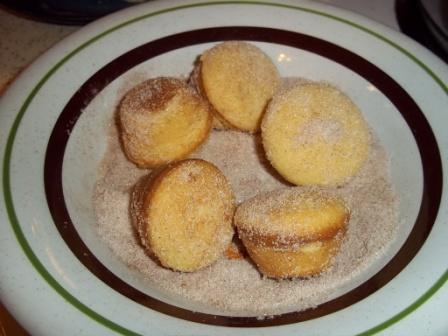
Makes 4-1/2 to 5 dozen mini DONUTS!!!!!!
NOTES
As I learned in experimenting with my mostly remembered recipe, a little bit of nutmeg will go a long way. I used a full tsp of nutmeg, but cut it back in the recipe for you because it got a little overpowering...it's not going to stop anyone from eating them, but you don't want them sitting around forever.
As I also learned, in order to avoid donuts with muffin tops, it is key not to fill your muffin tin spaces any more than 2/3 full. That way they will bake up to just the rim of the space and not over.
I would recommend putting some paper towels or a sheet of wax paper under your rack to catch any sugars that fall off when you rack the donuts.
And the reason you want to let the donuts cool is so that they will set. The warmer they are, the softer they are and the more likely they are to fall apart in your hand.
Subscribe to:
Posts (Atom)
