Google Groups
Subscribe to The Culinary Creative
Email:
Visit this group

Sunday, July 14, 2013

Blackberry Marbled Pound Cake

 
The past couple of weekends I've been religiously making the early morning sojourn to the Farmer's Market to get first dibs on the blackberry stash.  Learned very early on that they go fast and furious and with a short season, need to get them while I can.

Outside of my normal blackberry addiction, I've been hoarding them because it's cordial-making time in the K2 kitchen.  After the requisite batches, I found myself with some extra berries and thought I'd try something new so here you go.

Blackberry Marbled Pound Cake

3/4 cup butter, softened
3/4 cup sugar
1 tsp. vanilla
3 eggs
1-1/4 cups all-purpose flour
1/2 tsp. baking powder
1/4 tsp. salt
3/4 cup blackberry puree (approx. 1-1/2 cups full berries)

In a large bowl, cream butter and sugar until smooth.  Add in vanilla and mix until blended.

Add in the eggs, one at a time, until well incorporated.

 
In a separate small dish, combine your dry ingredients and then stir into the creamed mixture until smooth.


In a blender or food process, puree the whole blackberries (only takes about 30 seconds).

Messy mix the pureed blackberries into the batter.  By "messy mix" I mean very loosely fold without fully blending the puree in so that it will have that marbled look.


Light grease the bottom of a loaf and carefully pour the batter into it.  Carefully as to retain the marbled effect while baking.


Bake at 350 degrees for 40-50 minutes, or until an inserted toothpick comes out clean.


Set pan on a rack to cool.  Let sit in pan about 5-7 minutes, then loosen the sides and turn out of the pan to finish cooling.

NOTES

The blackberry puree will be as sweet as your berries are when you puree them.  If you need to sweeten them up a bit, just add a mere sprinkle of sugar to it. 

If you're not a huge blackberry fan (which is ridiculous, of course), you could always substitute another fruit puree.  Raspberries or even fresh peaches (which are currently in season) would work really well with this recipe too.

You can serve this will ice cream and top with fresh berries.  According to the Guinea Pig Parents, it also toasts up really well and, with a nice light smear of butter, is quite tasty.

Wednesday, July 10, 2013

Red Coleslaw

 
Since white coleslaw got its day in the sun, figured I couldn't let you go without adding a "red" slaw to your NC BBQ repertoire.

If you like things with a kicky tang, then this peppery slaw will be just the ticket.  Red slaw is also known in some circles as "barbeque slaw" and is oftentimes used as a condiment on hot dogs, burgers, or pork sandwiches.  Because of it's vinegar-base, its not unlike sauerkraut, but much less pungent and much more crunchy because it hasn't been fermented like kraut has.

Red Coleslaw

4 cups finely chopped green cabbage, raw
1/3 cup ketchup
6 tbsp. apple cider vinegar
1 tbsp. sugar
1 tsp. crushed red pepper flakes
2 dashes Tabasco sauce
1/4 tsp. salt
1/4 tsp. black pepper

In a medium size bowl whisk together ketchup, cider vinegar, sugar, pepper flakes, tabasco, salt and pepper.

Cut your cabbage very fine and add it to the mixture.


Mix together well.  Put in the fridge for at least 1 hour to allow flavors to blend.


Serve up with your favorite BBQ dish.

Sunday, July 7, 2013

White Coleslaw

 
Did you know...the term "coleslaw" is the anglicanized version of the Dutch word "koolsla" which is short for "koolsalade" which literally means "cabbage salad"?  Both the word and the dish were brought to the U.S. by Dutch and German settlers.

Since the 18th century, coleslaw has been a popular side dish, usually served cold, consisting of raw chopped cabbage dressed with mayo or buttermilk or vinegar.  Oftentimes spices, or carrots or sometimes even fruit (like pineapple or apples) is added to the dish.

If you like a traditional slaw, here is a simple recipe to follow.  In the land of NC BBQ, it's known as "white" slaw.  It's a mayo-based salad with a crunchy refreshing taste that nicely offsets the tanginess of a heapin' helpin' of sauce-drenched drenched pulled pork.

White Coleslaw

3 cups finely chopped green cabbage, raw
1/2 cup finely chopped carrot, raw
1/2 cup  mayonnaise
4 tsp. white vinegar
2 tsp. sugar
1/2 tsp. celery seed
1/4 tsp. black pepper
1/8 tsp. salt

In a medium size bowl, blend together the mayo, vinegar, sugar, celery seed, pepper and salt.


Add in the chopped cabbage and chopped carrot.

Mix well and allow to sit for 30 minutes to allow flavors to blend.


NOTE

In the photo, we served up the white slaw with an Eastern-style (vinegar-based) pulled pork BBQ which is why it looks like nothing is on it meat.

Thursday, July 4, 2013

BBQ Sauces

 
Happy 4th of July!!!

Hope everyone is having a day filled with family, friends, food and fun.  As promised, here are a couple of sauces for you to try.  We're doing pulled pork (thank you Mom!) and pulled chicken for our celebratory feast.

I've got an Eastern NC-influenced sauce and a Lexington-style sauce for you to try.  Enjoy.

Eastern NC BBQ Sauce

1 cup apple cider vinegar
3/4 cup white vinegar
1 tbsp. brown sugar
1 tbsp. cayenne pepper
2 tsp. Tabasco sauce
1 tsp. crushed red pepper flakes
1 tsp. black pepper
1 tsp. salt

Blend all ingredients together. Refrigerate for at least 3 hours, stirring occasionally (to make sure sugar dissolves), to allow flavors to blend.

Serve up with pulled pork.


Lexington-style NC BBQ Sauce

1 cup apple cider vinegar
1/2 cup ketchup
2 tbsp. Worchestershire sauce
2 tbsp. brown sugar
1/2 tsp. chili powder
1/2 tsp. salt
5-6 dashes Tabasco

Blend all ingredients together. Refrigerate for at least 1 hour to allow flavors to blend.

For both sauces, you want to make sure the sauces are at room temperature, though you can heat them a little before serving (so that you are not putting cold sauce on hot pork).

Serve up with pulled pork.


"Quick"-n-Easy Pulled Pork

6 lb. bone-in pork butt

Place pork butt in a foil-lined pan, fat side up.  That way the drippings from the fat will cook into the meat keeping it moist.

Bake at 325 degrees for 6 hours.  Drop oven temperature to 300 degrees, continue to cook for 1 hour. 


Remove loin from oven.  Using a pair of forks, pull the meet from the bone and crisped fat.


Serve up with favorite sauce.

Monday, July 1, 2013

NC BBQ

Major Procrastination + Late Night Trip to Small Animal Emergency Room = Monday Post...that's what I call bad math.  Just a heads up, since I'm rolling "one day off" this week, you can expect the next post on the Fourth. (p.s. the cat is fine, having survived both the mystery symptoms and my overwhelming pleasure at getting to drive 30 minutes in the rain on a Sunday night)


Summertime in the South, the weather may be hot but it doesn't stop us from enjoying a cold beer and some outdoor eating.  With the Fourth coming up this week, I thought it would be a good time to talk about that Southern classic -- BBQ.

Now here in North Carolina, we take our BBQ very seriously.  I'll be the first to confess that I was a late convert to the joys of a "pulled" plate.  Growing up in the north, to me BBQ meant the torturously delicious smelling slow-roasted rack of ribs my mom used to make, smothered in a thick ketchup-y sauce that was worthy of a stack of napkins.  So you can imagine my surprise when I order BBQ in NC for the first time and someone put in front of me what at first glance appeared to be a plate fancy dog food.  But man-oh-man, I've been a Southern BBQ addict ever since that first bite.

Throughout the South, BBQ generally refers to pork that's been slow-cooked over coals and then served either chopped, sliced, or pulled and covered with sauce.  The Spanish explorers were the ones to introduce pigs to the Americas and the native Indians in turn taught them their slow-cooking process. A big shout out to both cultures for making American pork BBQ possible.

In the 19th century, especially in the rural South, pigs were a low maintenance, easily available food source.  Pigs could be released into the woods where they would forage for themselves and then easily brought down when food was needed.  Eventually, pigs were domesticated and kept on the farm to fatten up for feasting. 

Waste not, want not was a concept put to practice when it came time to slaughter time.  Every part of the pig was utilized and put to good use.  It was either eaten immediately or cured for later consumption.  All parts -- ears, organs, etc. -- were turned into something edible.  Though if you've ever been introduced to scrapple, I'm not sure "edible" is a word I would use personally.

Slaughter time became a great reason to gather everyone for a get-together and where the tradition of a "pig pickin'" started.  People would dig a big pit and put a whole pig in to roast, from which the slow-cooked tender meat would then get "picked" and served up with a sauce made by the person running the pit.  Add in some pot-lucked sides (or "fixins") and you had a good time on your hands.  The pig pits got some pretty good use and over time, BBQ joints sprouted up around many of these BBQ pits, many of which are still being run today.

In NC, I used to think we only had two styles of BBQ, but as it turns out, we have three.

On the eastern part of the state, pork is served chopped or sliced with a vinegar-based sauce, emphasis on the peppery. It's usually served with coleslaw and hush puppies.

On the western part of the state, pork is served chopped or pulled with a ketchup-based sauce and served with cornbread and sometimes a Brunswick stew (stew made with vegetables, wild game like rabbit, and chicken).

And in the middle of the state (west of Raleigh, but east of the mountains), it's a mix.  You get Lexington-style BBQ sauce which is a blend of vinegar and ketchup, and BBQ is served with cornbread or hush puppies, and red or white coleslaw (yes, we even have two types of slaw).

If you go to a BBQ place, you usually have the choice to order a "BBQ tray" which is pulled pork and coleslaw with a side of puppies or you can order a "BBQ plate" which is pulled pork on a bun, served with coleslaw and fries.  And the proper way to eat a pulled sandwich is with the coleslaw on the pork on the bun.  If you've never tried it before, do...it's a life-changer.

So there you go, NC BBQ 101.  Since I'm giving myself an extra day to pull something together this week, I'll see if I can scrounge up some good sauce recipes to share, and may a fixin' or two to go with.

Wednesday, June 26, 2013

Good and Good For You: Scallops


I know I usually do this the other way around...first tell you how good something is for you THEN do a recipe for it, but I figure we know each other well enough now that I can switch things up a bit.  Plus that pesky travel schedule got in the way and here we are.

SCALLOPS

So...scallops, good stuff them.  Not so pretty to look out before they are appealingly laid out for purchase display in the store.  The white, meaty treat, aka "nut" that you buy is actually the adductor muscle of the creature, but not the only edible part.  In other world cultures, the reddish-pink "coral" (reproductive gland) is also considered a delectable sea treat.

Scallops have a mild sweet flavor and are not very fishy (for those of us who don't really like super fishy fish).  Scallops are low in calorie (4 oz. = 100 calories) and low in fat.  They are very high in protein (lean protein) and while they are known to be a bit high in cholesterol, that is offset by all the good minerals and vitamins they do contain.

Scallops are a good source of phosphorus, needed for strong bones and teeth. as well as a good source of cysteine, an amino acid needed to maintain healthy skin, bone and hair.

Scallops are particularly good for your cardio health.  They contain lots of vitamin B12 which breakdown chemicals that can cause damage to your heart valves.  They are chocked full of omega-3 fatty acids (which helps with a smooth blood flow), magnesium (which helps lower blood pressure), and potassium (which helps maintain normal blood pressure).

They can be prepared many different ways, but seared is usually a quick and easy way to fix them up.  Then you can add them to salads or pasta.  Lightly cooked with some oil and lemon (or served up in a tasty béchamel sauce), they are always a treat.

When you buy scallops, you want those that are uniform in color (pearly white) with firm, moist flesh.  Scallops do cook up pretty fast and if you overcook them, they tend to get a little chewy so your best bet is to undercook them a bit.  They'll still be very edible.


Sunday, June 23, 2013

Scallops Bechamel on Toast


Since I'm in Maine visiting relatives, I figured it would be an act of sacrilege to leave the state without whipping up a little fresh seafood something-something.  Fortunately I have a generous family who stepped up to be my taste testers.  :)

I was going to call this "Chipped Scallops on Toast" a la "Chipped Beef on Toast" but my retired military uncle reminded me of the no-so-flattering nickname given to that taste treat, so I went with something a little more appealing.  No matter what you call it though, it is D-lish!

Scallops Bechamel on Toast

bechamel sauce
2 cups milk
4 tbsp (1/2 stick) butter
1/2 cup flour
1/4 tsp white pepper
1/4 tsp salt
1/8 tsp nutmeg

scallops mix
1 lb. fresh sea scallops, cut in half (or quarters depending on their size)
1 cup shitake mushrooms, chopped
1/2 cup ham steak, small diced
1 small onion, diced
1 tbsp minced garlic
1 tbsp olive oil

soft crusted French baguette, sliced
1-2 tsbp parmesan cheese

To make the sauce:

In a small saucepan, scald milk (aka heat to almost but not boiling).

In another heavy bottom saucepan, melt butter over low heat. Whisk in flour and blend until it forms a roux, cook for 1 minute then remove from heat.


Pour in half of the heated milk and mix until the roux is incorporated.


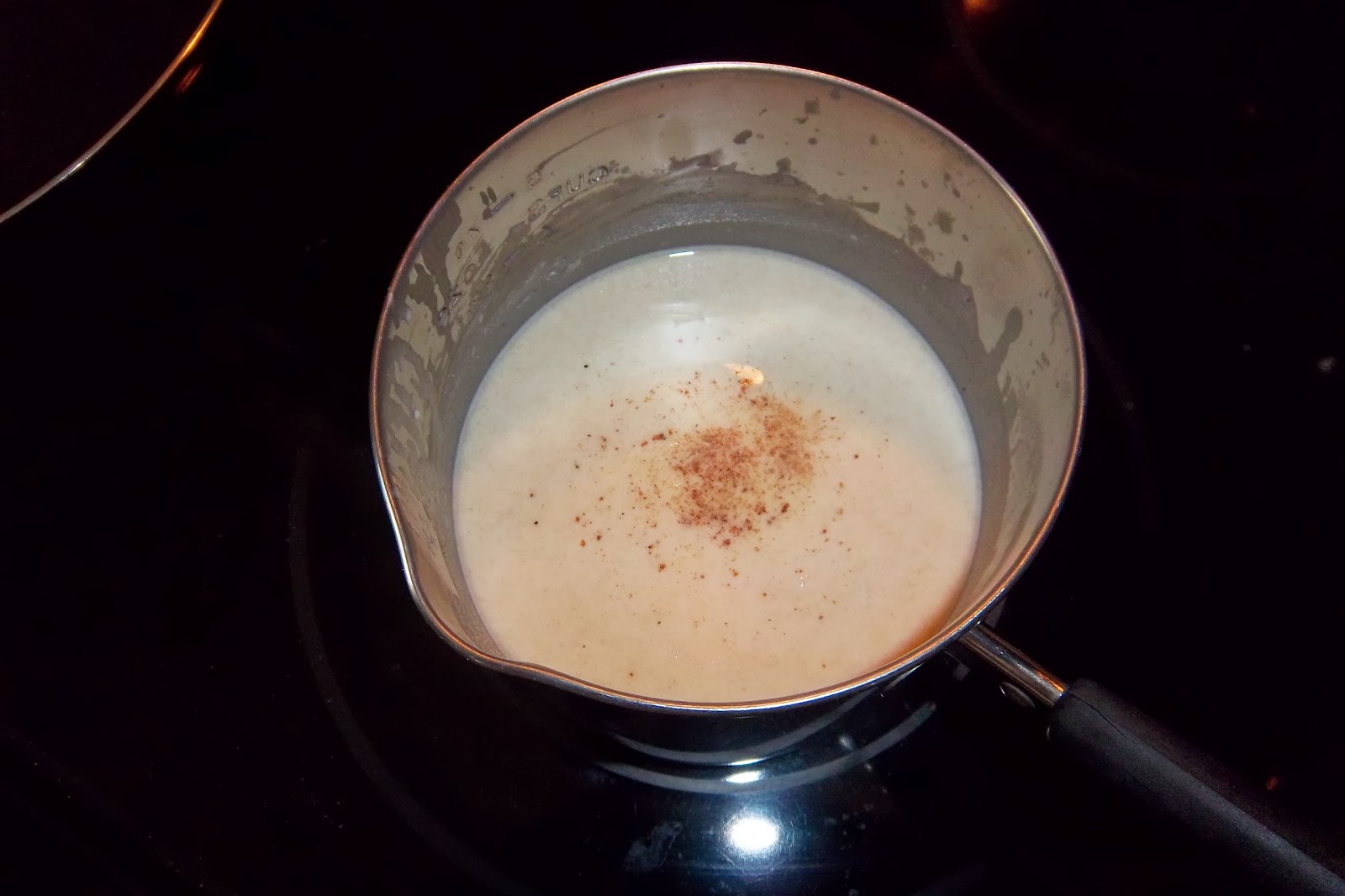
Return to low heat and stir until it thickens.  Add in rest of heated milk with white pepper, salt, and nutmeg.  You can adjust the seasoning to taste.


Remove from heat and set aside.

To prepare the scallop mix: 

Heat oil in a large skillet over medium heat.  Add in onions and garlic.  Cook 2-3 minutes or until the onions start to turn translucent.


Add in the scallops and cook for 3-4 minutes or until the scallops start turning opaque white (half cooked).

Add in the diced ham, and cook for 1-2 minutes.


Add in chopped shitake and cook for 1-2 minutes.


When the scallops are completely cooked, reduce the heat to low and pour in the prepared bechamel sauce.  Mix well, the sauce will thicken as it sits.


Remove from heat.

Slice the baguette into 1" thick slices (cut on a diagonal to make larger pieces).


Place the slices on a cookie sheet covered with foil.  Place the cookie sheet in an oven pre-heated to 350 degrees.  Toast until the top half starts to crisp up, then turn them all over and continue to toast until the second side is crispy as well.

Remove from oven.  Cover each slice with a generous spoonful of the scallop bechamel.  Sprinkle with parmesan cheese.


Set the oven to broil and place the cookie sheet under the broiler.  Cook for 1-2 minutes until tops are toasted.  Remove and serve.

NOTES

Want to send a special shout out to my favorite Maine-iacs for letting me commandeer the kitchen and use them as my guinea pigs.

From the oohs and aahs and happy grunting noises, I took that to mean the family thought it was pretty good.  It is fairly rich so be warned.

You want a soft bread to toast so that it will be crunchy (versus chewy). 

All of the chops and dices were small so that biting into the toast would be easy and not messy.


These can be made into appetizers or a meal, depending on how big you cut your bread.